Why Your Camera Roll Fails to Preserve Memories-What Will?

Have you ever wondered why your camera roll fails to preserve memories—and what will? If you’ve ever hunted for that photo—birthday cake, blue jacket, maybe 2021?—you already know: phones are brilliant at capturing moments and terrible at preserving memories.
It’s not you; it’s the system. In a single week your camera roll quietly becomes a utility drawer: your child’s smile next to a screenshot of bank details, a recipe, the neighbor’s missing cat poster, a parking sign, twenty near-identical takes of the same grin, and a few WhatsApp forwards. Somewhere in there are the moments you never want to lose—buried under everything else.
This post is about un-burying them.
Camera rolls capture. They don’t keep.
Your camera roll stores everything without a story. That’s the core problem.
-
No context. A photo alone doesn’t answer who, what, why this mattered.
-
Hard to find what matters. You remember feelings, not filenames.
-
Signal vs noise. The important shot blends into screenshots, flyers, and duplicates.
Bottom line: the roll is for capture. Memory needs curation.

WhatsApp makes the mess feel bigger
WhatsApp is great for sharing with family, but it spills into the chaos:
- Photos get separated from meaning. Your thoughtful message sits between logistics and
 .
. - Media scatters. Bits of the same day end up in multiple chats.
- Roll clutter. Even if auto-save is off, people still forward or download, and the thread’s context doesn’t travel with the image.
- Chats mix logistics and highlights, which makes them hard to revisit and preserve memories meaningfully.
Sharing is lovely. Archiving is different. A memory you plan to hand to your child deserves a home where it won’t be diluted by everything else in your life.
“I email my kid a Gmail address” — does it work?
A lot of parents create a Gmail account and send letters, photos, and voice memos to “future you.” There’s real goodness here:
What works well
- Private by default. It feels like a sealed letterbox.
- Timestamped and searchable. Easy to find a date or phrase.
- Easy to write. You can dash off a note from anywhere.
What breaks down over time
- Attachments aren’t an album. Photos live as scattered files, not a cohesive timeline.
- No story structure. Letters, images, and videos aren’t grouped by season (“Baby years,” “Grade 1”), person, or milestone.
- Handover is clunky. Credentials, security, and long-term access get awkward when it’s time to “gift” the account.
- Discovery is weak. Future-you can search for “first bike,” but not “the kitchen blackout disco when we danced while the power was out.”
If you’re already emailing: keep doing it. Then, once a month, pull your favorite letters and photos into a proper family archive where they’ll live together as a story.
What really helps us preserve memories?
Think in three verbs: choose, explain, connect.
- Choose a handful of keepers. One thoughtful photo beats forty lookalikes.
- Explain in a few sentences: who/what/why it mattered. Add the tiny detail your future self will forget—the song playing, the joke told, the way your toddler insisted the moon was following the car.
- Connect each entry to people and seasons of life: “Firsts,” “Grandparents,” “Home #2,” “Grade 1.” That web lets your child step back into the feeling later.
Example
- Without context:
IMG_3456 • 15 Aug 2023 - With context: The kitchen blackout disco — Power cut at 7:12 pm, pasta halfway cooked. You asked for “the happy song,” so we danced by phone light until the water boiled again. You laughed hardest when Dad spun you like a helicopter.
Which one will your child remember?
A 10-minute weekly ritual that works
You don’t need a new personality—just a habit.
- Pick 3–5 moments from the week (photos, short videos, or a voice note).
- Write 2–5 sentences using one of these prompts:
- First time: “Today you [first]. You were [emotion]. We celebrated by [tiny ritual].”
- Ordinary magic: “Nothing on the calendar. At 4:17 pm you asked me to watch you [small thing], and it became my best moment.”
- Behind the photo: “What you can’t see is [context], and that’s why this smile hits me.”
- Quote keeper: “You said: ‘[exact words].’ We’re saving this forever.”
- Tag and group by child, season, and theme.
- Share privately with the people who care (if you want).
- Keep it in one home built to last.
Do that most weeks and you’ll create a time capsule that reads like a story, not a scroll. Consistency, not perfection, is what helps families preserve memories that feel alive years later.
Photo books are great—after the habit
Photo books are highlights; your archive is the story. Capture context now, then build books from your best-of moments whenever you’re ready.
Privacy, future-proofing, and the “handover”
Your child’s story should live someplace:
- Private by default (you control who sees what).
- Built for families (letters, photos, video, voice in one place).
- Searchable by meaning (people, seasons, tags, not just dates).
- Ready to hand over when it’s their time to own their story.
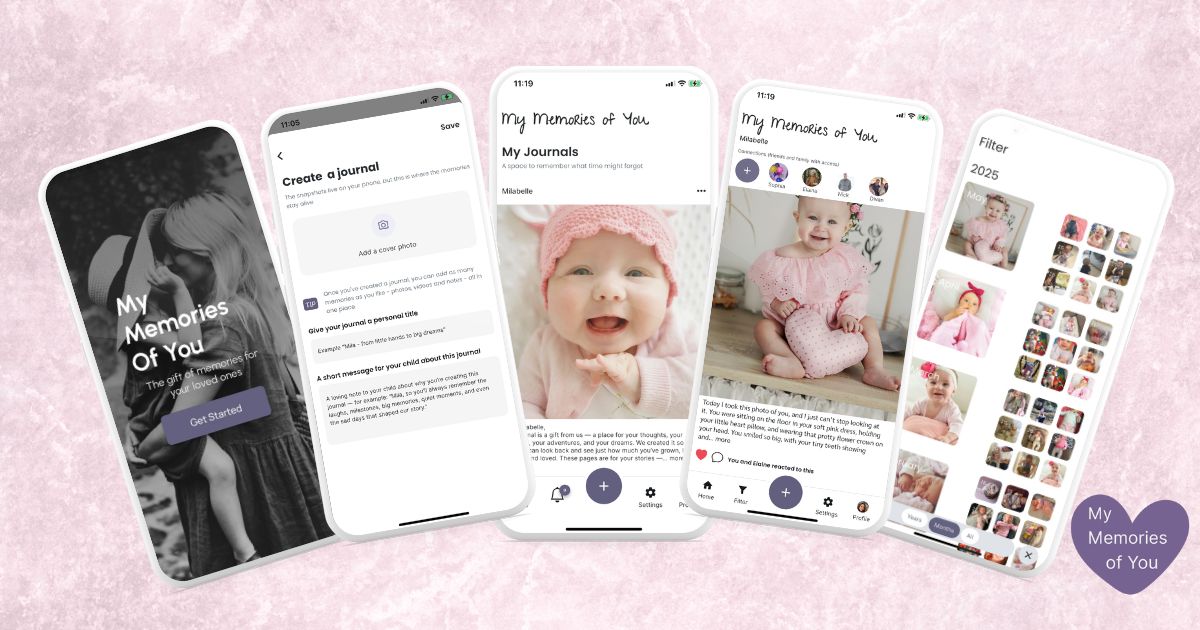
That’s the mindset behind My Memories of You: a private family journal designed so your child can one day open it and instantly feel what it was like to be loved by you.
Give their memories a good home with My Memories of You.
Camera rolls and chats capture everything; My Memories of You keeps the right things—context, curation, and a single private place so your child can revisit their story later.
At the end of the day, it’s not the number of photos that matter—it’s whether you preserve memories in a way your family can revisit.
Try My Memories of You free for 30 days—capture, add context, and revisit the moments that matter.